Detailed product description
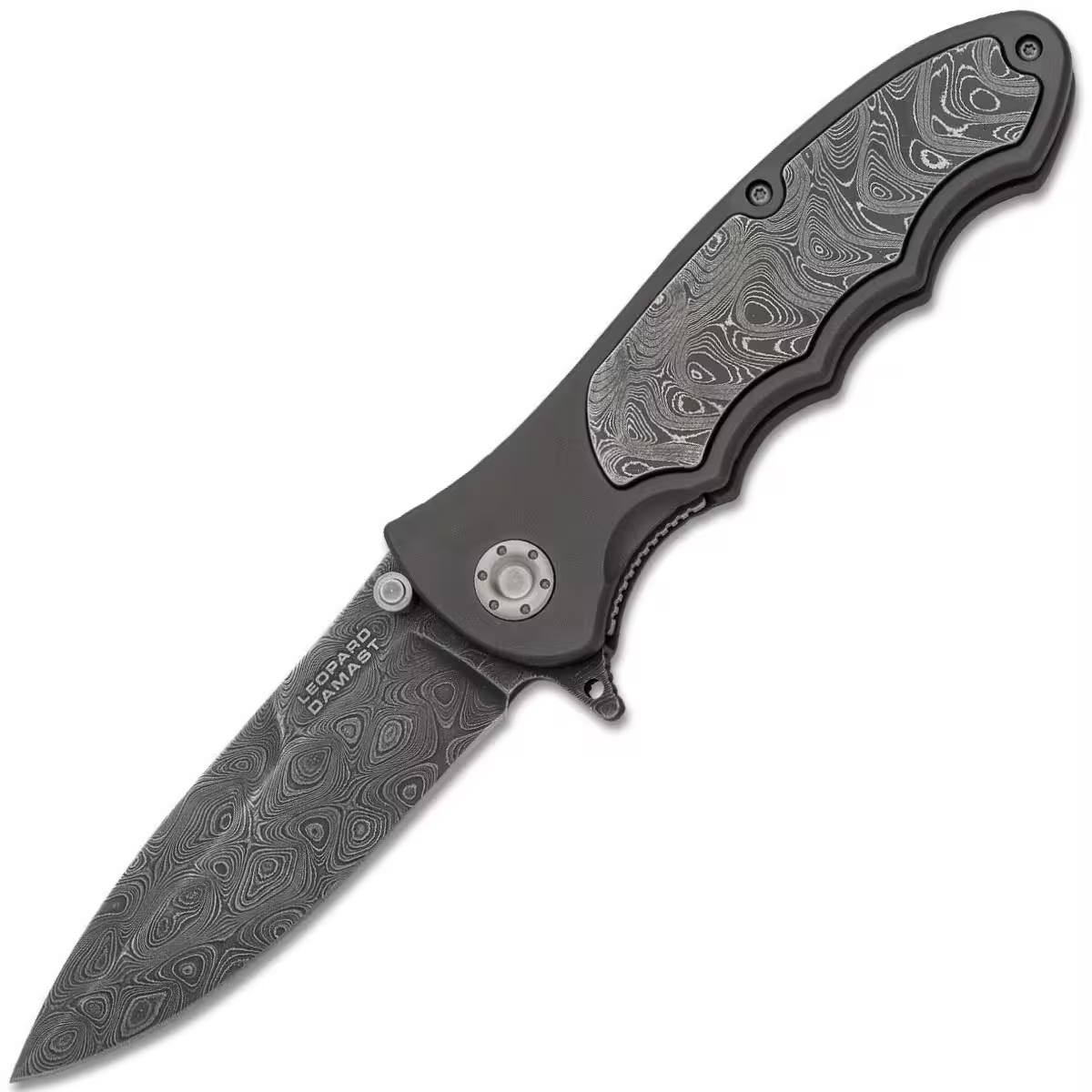
Böker Leopard-Damast III Damascus Folding Knife 110239DAM.
Many Boker customers asked them to offer a Boker Leopard Damascus III Collection edition with flipper and thumb stud. This collector’s knife features a beautiful inlay of stainless 180-layer Damascus, skillfully hand-set into the handle scale. This gives the pocket knife a new appeal, as the Damascus inlay with its elegant pattern works exceptionally well with the hand-forged Leopard Damascus blade. Böker’s legendary blade steel has been popular in the knife community for many years. It is made from the barrel of a Leopard tank, has 300 layers and a hardness of 61 to 63 HRC. With ambidextrous pocket clip (tip-up/tip-down). Comes with a frame case, certificate of authenticity and individual serial number.
Damascus steel
Damascus steel is the name of a type of steel that was very popular in the Middle Ages and the early modern period. It was named after the Syrian city of Damascus, formerly a trading center for knives and swords with this type of blade. Damascus steel is not as widely used today as stainless or carbon steel, but it is still valued for its decorative appearance.
Damascus is a composite steel, meaning steel made from two or more steel bases with different properties. The finished product has a clearly visible texture of alternating layers of the base materials. Two or more types of steel are used to create the composite in order to achieve a finished product that combines their strengths. Damascus steel was developed to offset the disadvantages of steel as a material in the manufacture of swords, knives and other weapons. Using hard or soft steel to make blades led to specific advantages and disadvantages: blades made from hard steel are very strong and retain their edge for a long time, but they are also brittle and break quickly. Blades made from soft steel, on the other hand, do not break, but bend quickly and lose their edge.
The combination of hard and soft steel typical of Damascus results in a finished product that does not break (like soft steel) while still offering good edge retention (like hard steel). The base materials of Damascus steel are usually welded together. The steel layers are forge-welded according to the basic principle: finer layers of steel bond better and more easily. It is not unusual for several hundred layers to be welded into a single blade.
Damascus steel no longer plays a role in blade manufacturing today because of the availability of mono-steel products (made from a single type of steel) offering the same properties that Damascus steel achieves by combining two or more types of steel. Damascus steel is still valued for its decorative exterior and long history.